

“They denounced my work on the floor of the Senate as they passed the legislation. And President Bush publicly said he thought the work was disgraceful. So here I am 24 years old and the President of the United States knows I exist and doesn’t like what I’m doing, and I think, I must be doing something right, this is good!”
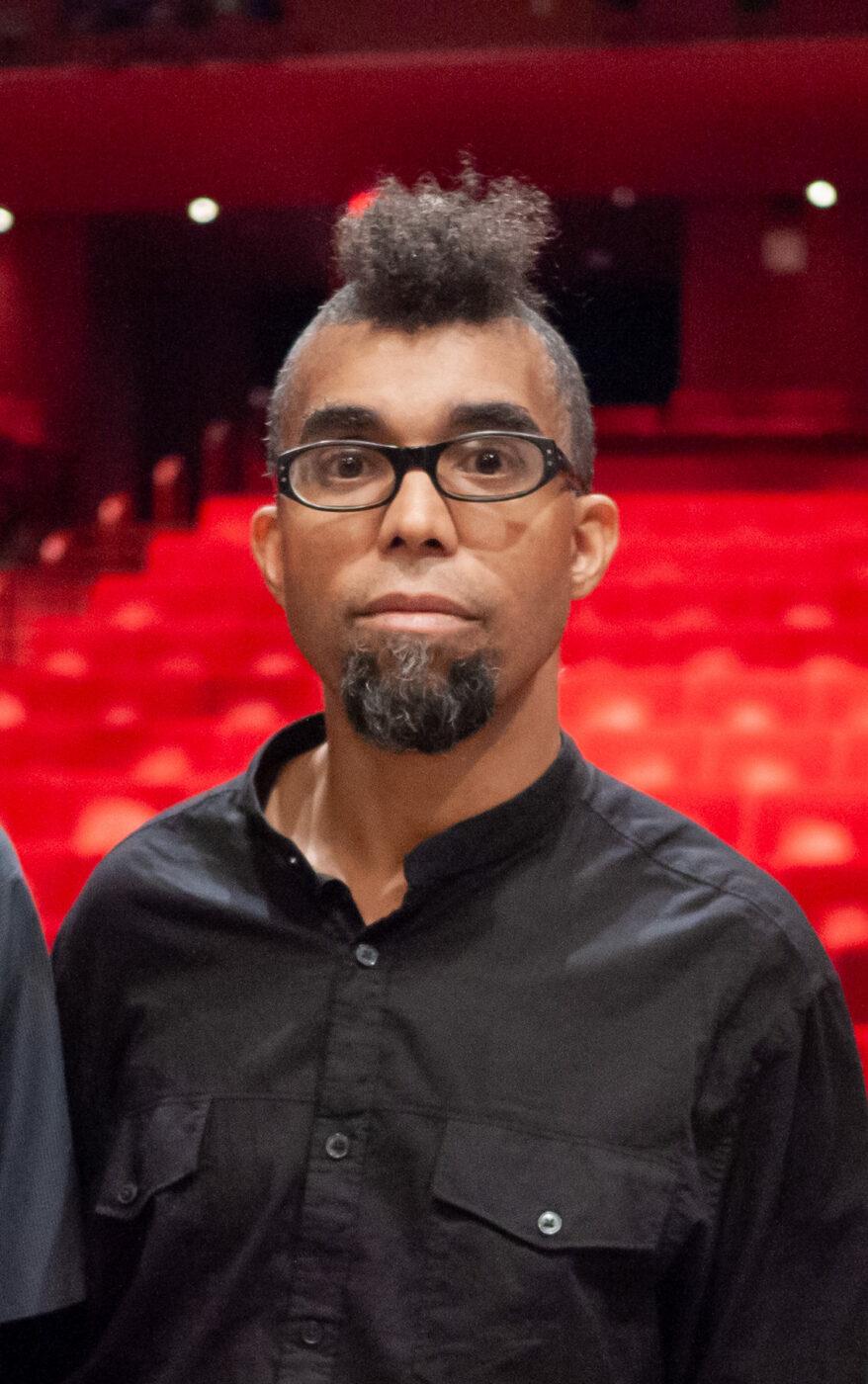
You may already know the work of Dread Scott. He first received national attention as a student in 1989 when his art became the center of controversy over its use of the American flag. President George H.W. Bush, declared What is the Proper Way to Display a U.S. Flag? “disgraceful” and the work was denounced by the US Senate. Since those inflammatory beginnings, Dread has gone on to show in venues like the Whitney Biennial, the Brooklyn Museum. His sculpture has been installed in Philadelphia’s Logan Square and the Franconia Sculpture Park in Minnesota, and his artwork is in the permanent collection of Whitney Museum of American Art, the New Museum of Contemporary Art, and the Akron Art Museum. Dread is a revolutionary communist living in Brooklyn, NY.
DreadScott.net
The interview
Steve & Stephen: Tell us how you got into making art with a social impact…and how you tell if your art has an impact?
Dread Scott: For a long time I was an artist and for a long time I was sort of a political activist and a communist, and the two weren’t coming together. And so on the one hand I was organizing, going to demonstrations, on the other hand, I was making art because I just liked it. I was sort of intentionally not bringing the politics into the art, and at a certain point, I said, this is stupid. This is really ridiculous. I’m committed politically to making a whole radically different world, and why shouldn’t art be part of that?
I made some forays and experiments into installation work for audience participation because I wanted to do artwork people couldn’t just dismiss the politics of. Whether they liked it or didn’t like it, whether they agreed with me or didn’t agree with me, I wanted them to have some engagement with the work. So even if they thought, “this guy’s a real asshole and he has no clue what he’s talking about,” I wanted them to be very much bound up with saying, “this guy’s a real asshole and he has no clue what he’s talking about.” And have that be part of the work.
I started doing these works that had photo montages on the walls, and encouraged people to take a copy and explain why they chose to take it in the book below. So it was this participatory piece. I started doing these, and I kind of thought they were successful. But look, I was an art student in an art school; it was seen by dozens or hundreds of people on a good day.
Posing a question… and getting answers
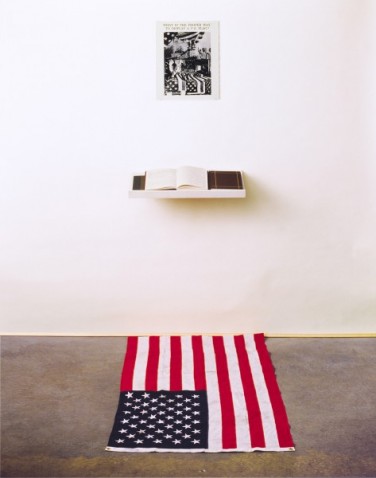
Then I did this other work that was part of that series, another installation for audience participation. It had a photo montage on the wall, and the text, “What’s the proper way to display a U.S. flag?” Kind of a simple question. The photos included South Korean students burning flags, holding signs saying, ‘Yankee go home, son-of-a-bitch’. Below that were flag-draped coffins coming home from Vietnam in a troop transport. Then there was a shelf where people could write responses to the question, “What’s the proper way to display a U.S. flag?” And there was a three by five foot flag that people had the option of standing, on if they wanted to, as they wrote the response to the question.
…by interacting with it you have the opportunity of transgressing. You don’t have to, but you can.
So again it was carrying forward this logic of: you’re part of the work. You might disagree with my views on the flag in America, you might agree with them, you might not know what they are, you might not care, but you are part of this work. And by interacting with it you have the opportunity of transgressing. You don’t have to, but you can. So it was this work that ironically posed a simple question and enabled people to enter into the discussion about it, but then it also provided the option for an answer that typically wouldn’t be thought about. That many people who sort of are personally the victims of America and American imperialism or just hate what it does in the world can say, wait, my views are welcome within this discourse. It allows for that to happen. And so people saw that and they debated.
S&S: What did they say?
DS: Some people wrote, “wow, this is really great,” or wrote, “thank you for this opportunity, the police killed my brother and they walked over to him and kicked over the body to quote, ‘make sure the nigger was dead,’ and that cop who shot my brother wore a flag on his arm. Thank you for the opportunity to stand on Old Glory.” And other people said, “look, you should be shot and be made to pay for the bullets,” and “you should go to Russia and try that.” And “what would you expect from a nigger from Africa like Dread Scott?” or something. And then there more contemplative people who said, “I’m not sure I really agree with you, but seeing people want to kill you makes me rethink what this country’s about.”
The reactions were all over the place, but people stood in line for 45 minutes to an hour to see the work. It was debated. You know, people from the housing projects would go see it. All sorts of people saw it and entered into the dialogue. Then people were having demonstrations for and against all across the country, including right on the steps of the museum, and calling for my death and saying, “the flag and the artist, hang them both high.” That’s what they wanted; when they saw that work, they were like, let’s lynch this guy. And it did get to the point where the U.S. Congress ended up adding words to legislation to “protect the flag,” which specifically outlawed the work. They denounced my work on the floor of the Senate as they passed the legislation. And President Bush publicly said he thought the work was “disgraceful.”
So here I am, 24 years old, and the President of the United States knows I exist and doesn’t like what I’m doing. I think, I must be doing something right. This is good!
So yeah, that’s my success story.
S&S: That’s intense and amazing, but let’s get back to the point at hand. What exactly makes this successful?
DS: Prior to that I had come to the understanding that art could affect the world, art could change things. But if you really pressed me on it, I would have said, yeah, if your name is Stephen Spielberg or Chuck D and you make things that are seen by millions of people. I’m a visual artist and even as a successful visual artist my work might be seen by a thousand people.
With art? Well, it is a little bit more abstract. If the criteria becomes, “did it sell?” then you’ve got a problem. I think with some art schools and some artists that is what success is: how many paintings you sell. That’s a problem.
But here was this work by this art student at an art school in a group show in the Midwest that was being debated and discussed all over the country. At that point I understood you don’t have to be working in mass culture to actually have work that can be successful.
With medicine: did the patient die? Okay, that treatment didn’t work. Math: well did you solve this conjecture? Yes or no. With art? Well, it is a little bit more abstract. If the criteria becomes, “did it sell?” then you’ve got a problem. I think with some art schools and some artists that is what success is: how many paintings you sell. That’s a problem.
Burn Baby Burn
S&S: So is success making something inflammatory and then watching the fire?
DS: I don’t think that success is only when there’s a big ruckus around something and it’s seen and debated by millions. But it did really open my eyes, like wow, the content and the ideas in the work can matter. Tremendously. There are these questions that are up for discussion and art can make people think about that in new ways. That’s what’s successful – when people are really challenged to look at the world in new and deeper ways. And the point isn’t that you have to change people’s view. It may be successful and fundamentally reinforce views that you already have.
You know some people have said, “this guy’s just a shock artist he’s just trying to rile people up.” I don’t think there’s very much wrong with that, but that’s not actually what I’m trying to do.
I’m trying my best to make it really interesting work. Having works at the center of some controversy – those works could be shown in one context and nobody bats an eye. In another context they want to string you up. I never know when one of those things is going to happen or not. I think about audience. I think about social impact. I think about when work may or may not be controversial. I don’t let that determine the work per se, but I am thinking about it.
You know some people have said, “this guy’s just a shock artist he’s just trying to rile people up.” I don’t think there’s very much wrong with that, but that’s not actually what I’m trying to do. I’m more trying to make work that, as best I can, shows people what this world is, shows people how it could be radically different, and speaks to people’s deepest hopes, dreams, and aspirations and puts that out there. Work that shows some profound contradiction. Including showing what this system is and allowing people to grapple with a different future. I think a lot about how it’s going to impact them.
S&S: I think that you said it much more articulately than ‘I’m gonna sum it up’. There’s two things: one is, your work is about trying to get people to question things, or think about things, not question because as you said they might reinforce what they already thought, but you sort of press the question, put it out in front of them. And then the second thing is to expand the audience. So it’s not eighty kids in an art school, saying, hey, I’ve never thought about that, but instead hundreds of thousands of people who might never even go to see art or never question the flag or what have you. Is that…?
DS: I mean, I always strive to have the work seen by more than eighty kids in an art school. I think the critical thing is that art find an audience. We’re in Chelsea now, among successful, major commercial galleries. Not gonna be that many people there. You should always strive for the audience to be greater, but I think that if ideas actually correspond to the deepest interests of humanity and you really wrangle with that and get people thinking about that, then that’s what’s important. Jumping to science, Einstein was working on the special theory of relativity before he even got to the general theory of relativity, and there were only a smallish number of people that got what he was saying before everybody then popularly understood e=mc2. Or even Darwin. There was an initial period before it jumped out of the box and became like, oh my god, this person’s calling on us to rethink how we thought about life as we know it. Before it got to that point, here were just a small number of people. Darwin was right, Einstein was right, and those ideas matter, but they weren’t guaranteed to have the ascendancy that they do. But it really mattered for them to have that ascendancy for those ideas to connect with a few people initially, to transform their thinking. And so it’s like, I don’t presume that I’m going to be the next Einstein or Darwin, but the point is the intellectual ferment and the intellectual debate and discourse matters and you never know where those ideas are going to go. You might be at a time when it’s not possible for certain ideas to resonate broadly, broadly, broadly in society. At other times they were.
…had that come out five years earlier or five years later it would not have the huge societal impact that it did.
With What’s the Proper Way to Display a U.S. Flag?, had that come out five years earlier or five years later it would not have the huge societal impact that it did. It still would have been a very good and important work and for the people that saw it, it would have been important. And the ideas they thought about would have been important ideological wrangling. But it wouldn’t have necessarily had this huge effect and impact that it did, and so I do think that yes, you try to expand audiences. But the thing is, you try to get at questions deeply, go for big questions at the moment, and get the work into people’s hands and have them wrestle with it.
Ideas & Actions
S&S: Let’s talk about ideas and their role in changing society. What’s the Proper Way to Display a U.S. Flag? is a great example of an idea at the right time that spread. But then what? Like, who the fuck cares about ideas? A thought doesn’t necessarily have a direct impact on the world. Everybody has ideas, you know? Let’s say you change hundreds of thousands of people’s ideas about something, then what? What’s the next step?
DS: Well, it depends on what ideas you have. And what ideas you change. And what moment you change them in. Look at the ideas Adolf Hitler had. He happened to, at the right time, get ideas to the right people and create a monstrous society that slaughtered 20 million. That was based on ideas. Those ideas resonated.
On the positive side: a guy named Marx had some ideas. And those ideas were fundamentally looking at the historical development of humanity to a certain point and saying, this is where we’ve gotten to, this is where it could go. This is what capitalism is: we’re in system where a tiny handful controls the wealth and knowledge that humanity as a whole has created. It doesn’t have to be that way. People can make conscious revolution. They can actually seize state power and get to a classless future. People in Russia made revolution based on that idea. Lenin got what Marx understood and deepened that and said, you need a disciplined party, you actually need…
S&S: Ok, fair enough, ideas can have impact. But how do you get from people interacting with the artwork, delivering ideas, and changing people’s minds, all the way to the necessity of the Party and seizing state power?
DS: Well, I agree, I think people need state power, and there’s people working in the world who are actively organizing people to make resistance and support a new society. I know that that’s happening.
My art is art. It is artwork, it is not political machinery, it is not an organization. It does not translate in a one-to-one basis to “people see art, then they’re communists, then we get state power.” It’s not that simple. And God I hope it never gets reduced down to that. My art or anybody’s art.
They were trying to make a new aesthetic with new ideas. Making a whole new culture, a whole new society, a whole new world. And so that’s kind of how I think the art works.
I don’t even think it has to be so direct. You look at some of the constructivist stuff from the Soviet Union. Those were people very passionately saying, this is work for the revolution. But it wasn’t reductive to: big, strong muscle-y workers with hammers and sickles. They were trying to make a new aesthetic with new ideas. Making a whole new culture, a whole new society, a whole new world. And so that’s kind of how I think the art works.
What is to be done?
S&S: So you’ve got ideas over here and the ultimate goal, which is revolution and this new society, on the other end? What are the steps in between ideas or “me making stuff” and the actual change that you want?
DS: I think right now what is most needed is people to engage with communist ideas. The world needs a lot more communists and right now there’s, frankly most people, would say: It didn’t work. Move on. I say, actually, no. What’s really urgently needed is communism and it’s not going to happen spontaneously.
I want people to be engaged with communism. I don’t necessarily know what the impact is going to be in a linear sense. I don’t think a lot of work is reducible to that. But it’s very valuable to have those ideas out there and so when different streams come together, when there is more upheaval and foment in society then the ideas start to more get bound up with other people who are organizing to take the political stage. Communism is an idea that is just out there, but there needs to be some fighting around it. Does that idea, in and of itself lead to demonstrations and the seizure of power? Well, not necessarily, but you never know.
S&S: Wait, if a communist state isn’t going to happen spontaneously, how is it going to happen?
DS: I think on two levels. On one hand, I think sometimes the work is very directly connected to the either social questions or even organizing—I mean there’s the work that I was sort of a lead artist on called Our Grief is Not a Cry for War, which was a mass public performance right after September 11. These people stood around dressed in black, we wore dust masks, we had signs that said “Our Grief is Not a Cry for War.” And we stood silent and motionless for an hour. And people just watched and we watched back. And people could join in, we had extra signs. It was out there in the public, and we hoped to contribute to sort of an anti-war movement.
Whether it stopped the war? No. Whether it made revolution? No. But it did contribute in a very direct way. I think it’s fine for some work to be in service of movements. People need massive resistance from below, independent political action, and artists should be part of that, whether they make their work for demonstrations, whether they go to demonstrations, whether they organize demonstrations. At the same time, most of art shouldn’t be about that.
S&S: Why not? Why shouldn’t all art be about strong-armed, burly steelworkers and linked to the Party?
DS: It’s fucking boring.
Look, I like socialist realism. I think the socialist realist work that came up in the Soviet Union makes for some really amazing art. My god, intellectual life in the Soviet Union would have been stifling as hell, particularly in the arts. You aren’t actually going to get to a classless world if that’s how you manage your state. If you say, there’s only one proletarian form and every painting must include six workers and they must have muscles this big and they must have hammers this large… It’s like, no, you’re not actually going to unleash the foment that you need. You really aren’t.
One of my favorite books is Toni Morrison’s Beloved. It’s not in a certain sense directly political—it’s set in the period just during and just after slavery. It’s a ghost story in a certain sense. It isn’t about any lynching that’s happened now or any police murder that’s happened now or the treatment of women or abortion rights. Or how black people need to appreciate themselves now. But my God, it’s so profoundly related to one of the biggest questions in America: the question of the situation of black people. It wasn’t like, “oh, slavery’s bad.” It is. And it shows a lot of the horrors, but it shows how it affects the people that were enslaved.
And that book isn’t calling on anybody to go to a demonstration. It isn’t saying that this police murder was wrong, it isn’t saying that 1 in 9 black men shouldn’t be in prison. But it’s all there. Reading a book like that enables people to have a much richer understanding of what is fundamentally wrong with this society and why nothing good can come from it. You cannot tinker with it and get something good. No matter what you do. Frankly, you can put a black man in the White House but it ain’t gonna solve the problems that Beloved is hitting at.
S&S: While it’s much harder to articulate and measure, there’s a lot to be said for the impact of the poetic. Another way that we can sometimes get a handle on impact is to look at what obviously doesn’t work, so here’s our next question: can you think of a project where you spent a long time planning it, it had the best intentions, but it just kind of fell flat on its face? It just didn’t have the impact that you hoped for.
DS: No! I’m a genius. Everything I do works brilliantly!
S&S: OK, on to the next question!
The right time
DS: No, I mean, there are. I think all artists – as long as you keep making art beyond a week or two – some of your art is going to be better and some of it is going to be not as good. I want every work I make to be my best work. But it isn’t. It’s not been some linear progression. I want it to have some sort of impact – though not necessarily having presidents denounce it and stuff like that.
But there’s one work Project Lockdown — it’s a project where I’ve been going into prisons and jails, photographing and interviewing people, and telling a story of a country that imprisons 2 million people. I started that in 2000, and after September 11 it became a lot more difficult to do for three basic reasons. One, I couldn’t get funding as much after September 11 because if you were doing anything political or social it had to deal with international questions. You know, black people, people in prison – “we’re not interested in that!” Also because people were not interested in funding it, people were not interested in showing it. And finally, getting access to prisons became more difficult. I think it’s pretty good work, but I haven’t been able to finish it.
With that project there were some shortcomings that were my responsibility, but largely it was just timing didn’t work out. The work is still good, and I show it and I think a lot of people should see it. But it didn’t have the effect that I wanted it to.
I thought it was going to be like, wow, people are really engaged with how fundamental prisons are to this society and what people who are imprisoned had to say. That they’re not these beasts with no face, they have interesting ideas, they’ve learned a lot by being in the position they are in society, and they have a lot to say. So I thought that it would be more widely received. When I started I thought, this is gonna be a show in major institutions – and it has been shown in some museums. People who have seen the work like it. It didn’t fall flat but it wasn’t the smashing success I thought it was going to be.
I like cycling. If you’re a great bike rider and you’re riding in the Tour de France, and you happened to be riding in the seven years that Lance Armstrong is riding, you’re probably not going to win. Even if you’re a great cyclist. It’s just the balance of things didn’t work in your favor.

It’s like a sports team, you go out, play a good game and if you happen to be playing a team that’s better than you, you probably aren’t going to win. I like cycling. If you’re a great bike rider and you’re riding in the Tour de France, and you happened to be riding in the seven years that Lance Armstrong is riding, you’re probably not going to win. Even if you’re a great cyclist. It’s just the balance of things didn’t work in your favor. Let’s say you’re living in Mexico in 1935, you’re an abstract artist, more than likely you’re not going to get a lot of ascendancy. There’s this dude, Diego Rivera, working at the same time as you. Even if your work is really good and interesting, probably not your year.
S&S: It sounds like a lot just depends on context, a larger social context, the same thing you were talking about with ideas. Sometimes ideas have an historical moment and sometimes they don’t.
DS: Well, my goal isn’t utopia; my goal is rooted in material reality. Making revolution in an imperialist country, it ain’t been done before, it’s a long shot, let’s be real. People say, “oh yes, revolution, I’m a revolutionary” but it’s not as easy as that. Look back to the Sixties, I’m sure a lot of Black Panthers thought when they signed up that by 1973 we got it all hooked up. Ain’t gonna be. Sure, there were some shortcomings in their understanding but frankly, Lance was still in the race at that point. Had there been a revolutionary party earlier, and not just a black revolutionary nationalist party, but a genuine communist party with an advanced understanding, things might have played out differently. No guarantees, but Lance might not have been as competitive in that race.
And then how do I measure my art against that? Art is contributing to that process. And again, not in instrumental or reductive ways, but is it contributing to people further wanting to get rid of a society that’s based on exploitation and oppression and seeing the means to do that. And since the work isn’t always, or even usually, tied to: “come to this demonstration!” or: “write this letter to the editor!” or something like that, it’s not so simple. You make the work and then you talk with people, and say, how are you understanding this? And you learn from them, and you try and do better next time even if you’re very successful.
But, from my perspective, the yardstick is whether it’s contributing in as strong a way as possible to revolution and communism. Again that’s not like asking, is it making people want to go out and take up arms right now, but is it contributing to a process where they find this system that we now live under worthless and that another system radically better? And some people aren’t going to get that full thing from seeing a work, say, about police brutality, but they might further think, well this system is kind of worthless, it keeps murdering people time and time again. Shooting them in the back. And if it strengthens that understanding or makes them rupture with “I wanted to be a cop” then good.
Does that answer the question?
Enjoyed this? Have a look at our other interviews!